Someone who has forgotten a lip product before an evening out has a different shopping task from someone comparing foundation shades at a beauty counter. A makeup vending machine needs a product range and a buying experience that suit the first kind of quick, self-service decision.
That does not mean filling every channel with small cosmetics and hoping foot traffic will do the rest. The useful questions are more specific: what would someone need at this location, can they choose it without assistance, and will it arrive in good condition?
Build the range around a clear reason to buy
Start with the occasion. A hotel guest may want a forgotten essential. Someone at an event may need a quick touch-up. A shopper near a beauty retailer may be willing to try a familiar brand in a smaller format. These are different buying situations, even if the machines look identical.
For an initial range, consider sealed products with a clear purpose and relatively little explanation: lip balm, blotting papers, individually packaged applicators or a small selection of recognizable lip products. Each item still needs packaging and dispensing checks. Small size alone does not make it suitable.
Shade-dependent products need more careful presentation. A large foundation range can use many selections while leaving only a few units of each shade. If customers cannot confidently identify the right option, adding more choices may make the screen harder to use without solving the underlying problem.
Keep the first assortment small enough to learn from. Give each selection a job, such as an everyday essential, a touch-up item or a familiar branded product, and review actual sales before widening the range.
Give shade and size information before payment
A customer cannot ask a machine whether two colors are similar. The product page should therefore show the exact product name, shade name or code, pack size and what is included. Use an accurate image of the variant being sold rather than one generic photograph for an entire range.
For bundles, list every item. For miniature products, make the size obvious. A disappointed customer who expected a full-size product creates a service problem even when the machine dispensed correctly.
A screen image cannot guarantee how a shade will appear on someone’s skin. Avoid promises of a perfect match. Where useful, provide a clearly labeled link or QR code to the brand’s product information, while keeping the basic purchase decision understandable at the machine itself.
Check the package from loading to collection
Cosmetic packaging varies widely. A slim lipstick carton, a flexible sachet and a glass bottle do not move in the same way. Send the supplier the finished items you intend to sell, complete with seals, sleeves and any labels added for retail.
Ask to see repeated tests, including the last item in a channel. Check the delivered package for dents, scuffs, leaks and broken seals. For a compact or another fragile item, confirming that the outside carton survived is only part of the inspection.
Keep approved samples as a reference. If the brand changes its packaging, test the replacement before treating it as the same vending item.
Assess the location beyond its foot traffic
A busy corridor is not automatically a good place to sell makeup. Observe whether people can stop comfortably, read the screen and collect a purchase without blocking others. Consider the lighting, visibility from nearby activity and the practical route for restocking.
Ask the venue when the machine will be accessible. A unit behind locked doors cannot serve customers after the building closes. Agree who handles cleaning around it, how service staff gain access and whom to contact if the power or network connection is interrupted.
Storage conditions also belong in the location assessment. Follow the product manufacturer’s instructions and compare them with conditions inside the installed cabinet, including warmer periods. A touchscreen or enclosed cabinet does not establish that a machine provides temperature control. Confirm any required environmental features for the specific model.
Choose a machine around the assortment
Once the range and location are defined, compare cabinet formats. A wall-mounted unit may suit a site with suitable structural support and service clearance; another site may be better served by a different arrangement. Measure the open door and refill workspace, not just the closed cabinet.
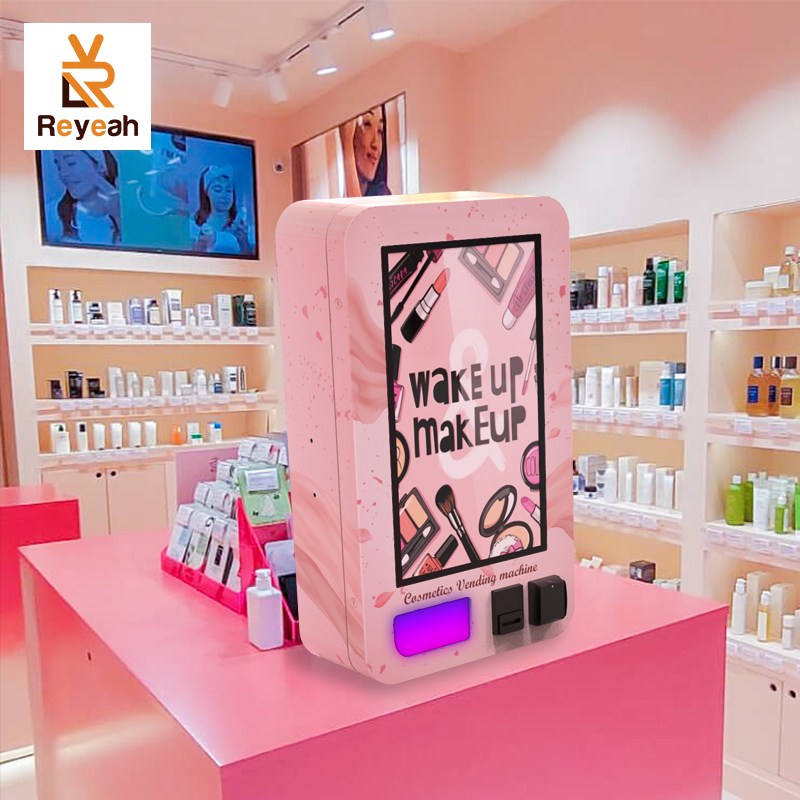
Reyeah’s FD12-02 makeup vending machine and G02 mini cosmetics vending machine are examples to discuss when reviewing compact formats. The product pages list customization support; confirm the current configuration, usable capacity and suitability for your samples before ordering.
Ask how much stock fits behind each selection. A range with one fast-selling lip balm and several slower shades may need uneven channel allocation. Equal space for every product is convenient on a drawing, but it can create unnecessary refill visits.
Keep checkout and customer support straightforward
Show the final price and selected variant before asking for payment. Confirm the supported payment methods for the operating country, along with activation requirements and recurring fees. Test the complete sequence on the configured machine.
There should also be a visible way to request help. Give the machine an identifier so customers can say which unit they used, and establish what information the operator needs to trace a transaction. Decide who handles a failed delivery or a wrong-item complaint before launch.
Use sealed retail stock from a traceable supply chain, and retain the product and batch information needed for stock control. Make manufacturer information easy to access rather than trying to fit every detail onto the selection screen.
Work out what remains after each sale
Sales revenue alone says little about whether a location is worth servicing. Deduct product cost, payment fees, any venue commission and an allowance for refunds or damaged stock. Then compare the remaining contribution with rent, connectivity, refill labor and other fixed expenses.
Use your actual quotation and venue agreement to build the calculation. Include delivery, installation, opening stock and spare parts in the launch budget. A machine that sells regularly can still be expensive to operate if every refill requires a long journey.
Let the first refill cycles shape the range
Track units sold by product and shade, empty-channel time, failed deliveries, refunds and time spent servicing the unit. Record what was unavailable as well as what sold: an empty channel cannot tell you how much additional demand it missed.
During refills, inspect packaging and seals, rotate stock according to the manufacturer’s shelf-life information, and remove damaged items. Compare the physical count with the machine’s records so errors do not accumulate unnoticed.
After several refill cycles, decide whether to give a popular product more space, remove a slow variant or improve an unclear product image. Make a small number of changes at a time so the next sales period tells you something useful.
If you are planning a makeup vending machine project, send Reyeah your product list and proposed location, together with package dimensions and the destination country. Those details make it possible to discuss a workable configuration before committing to the cabinet design.