Running a card vending machine business involves more than choosing the right products and finding a good location. You also need to think about how customers will pay.
Whether you’re selling Pokémon cards, trading card game (TCG) booster packs, sports cards, or collectible card boxes, the payment system plays an important role in the buying experience. A customer might be ready to purchase a $5 booster pack or a $100 collectible box, but if the machine doesn’t accept their preferred payment method, you could lose the sale.
Fortunately, modern card vending machines offer several payment options, from traditional cash payments to credit cards, mobile wallets, and QR codes.
In this guide, we’ll walk through the most common payment methods, how they work, and what you should consider before choosing a payment system for your card vending machine.
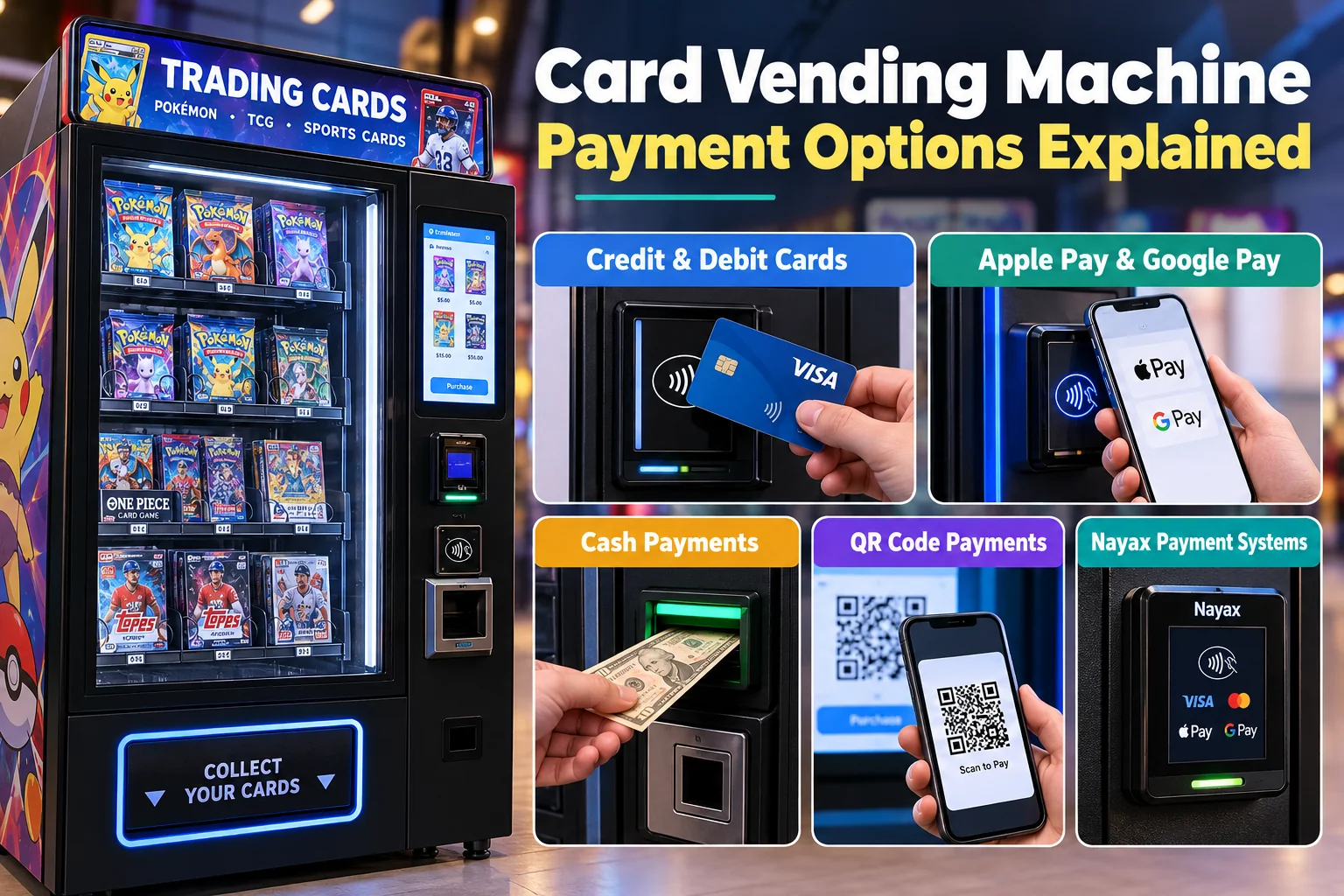
1. Credit and Debit Card Payments
Credit and debit cards are among the most practical payment methods for card vending machines, particularly in markets where cashless payments are widely used.
Customers can pay with supported cards, including Visa and Mastercard, without carrying cash or searching for exact change.
Depending on the installed card reader, a machine may support several ways to complete a transaction:
- Contactless payment: Customers tap their card against the reader.
- Chip card payment: Customers insert their card into the terminal.
- Magnetic stripe payment: Customers swipe their card if the reader supports this feature.
Contactless payment is particularly convenient for vending machines. It takes only a few seconds to present a card, making it suitable for busy shopping malls, game stores, entertainment venues, and other high-traffic locations.
For trading card vending machines, card payments are also useful when customers purchase more expensive products. Someone buying an Elite Trainer Box (ETB) or a premium sports card box may prefer using a bank card rather than carrying a large amount of cash.
However, card readers don’t automatically accept every bank card worldwide. Supported payment networks, transaction limits, and processing requirements depend on the payment provider and the country where the machine operates.
Before ordering a card vending machine, confirm that its payment terminal can accept the cards commonly used in your target market.
2. Apple Pay and Google Pay
Many customers now use their smartphones to make everyday purchases. For card vending machine operators, supporting mobile wallets can make the buying process even more convenient.
Apple Pay and Google Pay use NFC (Near Field Communication) technology to communicate with compatible contactless payment terminals.
Instead of taking out a physical bank card, customers can authorize a payment on their smartphone or compatible wearable device and hold it near the reader.
The process is straightforward:
- The customer selects a trading card product.
- The machine displays the purchase amount.
- The customer authorizes Apple Pay or Google Pay on their device.
- The customer holds the device near the NFC reader.
- Once the payment is approved, the machine dispenses the selected product.
For customers, the biggest advantage is convenience. They can buy a booster pack or collectible box without carrying a physical wallet.
For operators, mobile wallet compatibility can help accommodate different customer preferences, especially in locations frequented by younger shoppers and collectors.
It’s worth remembering that Apple Pay and Google Pay support depends on the actual payment terminal, its configuration, and the local payment processor.
A vending machine with a touchscreen doesn’t necessarily support mobile wallets. The installed payment hardware must be compatible.
3. Cash Payments: Coins and Banknotes
Despite the growing popularity of digital payments, cash remains useful in certain locations.
Some customers prefer paying with physical money, especially when buying inexpensive products. Others may not have access to a credit card or mobile wallet.
Card vending machines can be equipped with coin acceptors, bill validators, and change-dispensing mechanisms, depending on the machine configuration.
Coin acceptors recognize supported coin denominations and calculate the amount inserted.
Bill validators identify accepted banknotes and add their value to the customer’s available balance.
Change dispensers return the appropriate change when a customer pays more than the product price, provided the machine supports this function and has sufficient change available.
For example, if a booster pack costs $6 and a customer inserts a $10 bill, a properly configured cash system can return $4 in change.
Cash payments can be especially helpful in arcades, family entertainment centers, and locations where younger customers frequently purchase trading cards.
However, accepting cash also creates additional maintenance responsibilities.
Operators need to collect money, monitor coin levels, replenish change, and occasionally clean or service the payment mechanisms.
Cashless systems generally reduce these tasks, although they introduce payment processing fees and connectivity requirements.
For many operators, a combination of cash and cashless payments offers the most flexibility.
4. QR Code Payments
QR code payments are another option worth considering, particularly for card vending machines operating in markets where mobile payment apps are commonly used.
Depending on the payment system, customers may scan a QR code displayed on the machine or present a payment code from their mobile app.
The basic purchasing process typically involves selecting a product, opening a supported payment app, scanning or presenting the code, and confirming the transaction.
Once the payment platform confirms the transaction, the vending machine receives authorization to dispense the product.
QR code payment systems can be useful in markets where digital wallets and local payment apps are popular.
For example, buyers considering vending machines for different regions may want to investigate support for payment platforms such as Alipay, WeChat Pay, or other locally available QR payment services.
However, QR code compatibility varies significantly by country and payment provider.
A machine that supports QR payments in one market may require different software, merchant registration, or payment integration to operate in another.
Before choosing this option, ask your vending machine supplier which QR payment services are actually supported in your destination country.
5. Nayax Payment Systems for Card Vending Machines
If you’ve been researching trading card vending machines, you’ve probably come across Nayax.
Nayax provides cashless payment and management solutions for unattended retail equipment, including vending machines.
Compatible Nayax devices can support different payment methods, including credit cards, debit cards, contactless payments, and mobile wallets.
Some terminal models also support QR code payments and prepaid payment options.
For card vending machine operators, the appeal of a system like Nayax goes beyond collecting payments.
Depending on the device and service configuration, operators may be able to access transaction records, review sales performance, and remotely monitor connected vending machines.
Imagine operating several Pokémon card vending machines across different shopping centers.
Instead of relying entirely on manual sales records, a connected payment and management system can help you see which machines are generating sales and review transaction activity from a central platform.
This information can be valuable when deciding where to restock products or whether a particular location is performing well.
What about compatibility?
Many vending payment devices communicate with a machine’s controller through MDB (Multi-Drop Bus), a widely used vending industry protocol.
However, having an MDB interface doesn’t guarantee that every payment terminal will work immediately with every machine.
The machine controller, firmware, terminal configuration, and local payment processing arrangements must also be compatible.
It’s best to confirm the exact terminal model and integration requirements with your supplier before purchasing.
6. How Much Do Vending Machine Payment Systems Cost?
Payment processing costs are an important part of operating a profitable card vending machine business.
The total cost isn’t limited to the physical card reader.
Depending on the service provider, you may need to consider:
Card reader hardware: Some machines include payment hardware in the quoted price, while others offer it as an optional accessory.
Transaction fees: Payment processors may charge a percentage of each transaction, a fixed amount, or a combination of both.
Monthly service fees: Certain payment providers charge recurring fees for connectivity, reporting, or management services.
Mobile connectivity: Some payment terminals use cellular connections, which may involve SIM card or data service charges.
Merchant account requirements: Operators may need to register with an approved payment provider and complete identity or business verification.
These costs can make a noticeable difference when selling low-priced trading card products.
Consider a simple example.
If a booster pack sells for $5 and the hypothetical processing fee is 2.5% plus $0.10 per transaction, the payment processing cost would be:
$5 × 2.5% + $0.10 = $0.225
That’s approximately $0.23 per sale.
For a $50 card box under the same hypothetical fee structure, the processing cost would be $1.35.
These figures are examples, not actual Nayax rates. Real fees vary based on the provider, region, merchant agreement, and transaction type.
When comparing payment systems, pay attention to both the percentage fee and any fixed transaction charge. Fixed fees can have a relatively large impact on inexpensive products.
7. Which Payment Option Is Best for Your Card Vending Machine?
There isn’t one payment method that works best for every location.
The right choice depends on your customers, product prices, country, and business model.
Here’s a quick comparison:
| Payment Method | Main Advantage | Things to Consider |
|---|---|---|
| Credit/Debit Cards | Convenient for everyday purchases and higher-value products | Processing fees and merchant approval |
| Apple Pay/Google Pay | Fast contactless checkout | Requires a compatible NFC terminal |
| Cash | Accessible to customers who prefer physical money | Cash collection, maintenance, and change management |
| QR Code Payments | Useful in markets with popular local payment apps | Regional integration and merchant requirements |
| Prepaid Cards/Wallets | Can support repeat purchases and loyalty programs | Requires a compatible platform and customer adoption |
For a Pokémon card vending machine in a shopping mall, a contactless card reader supporting major bank cards and mobile wallets is often a sensible starting point.
For a machine in an arcade or family entertainment center, accepting both cash and cashless payments may be beneficial.
If you’re planning to operate machines in several countries, payment compatibility deserves even more attention. A solution that works in the United States may not have the same approval, coverage, or functionality in Europe, Asia, or Latin America.
The best approach is to choose your target location first, understand how customers prefer to pay, and then select a suitable payment configuration.
8. What to Check Before Buying a Card Vending Machine
Payment hardware should be part of your purchasing decision from the beginning, not something you think about after the machine arrives.
Before placing an order, ask your supplier a few practical questions.
Does the machine support the payment methods used in my country?
Check support for local bank cards, mobile wallets, and any regional payment applications you intend to accept.
Is the payment terminal included in the machine price?
A quotation may cover the vending machine but exclude the card reader, installation, or payment service activation.
Are there recurring payment service fees?
Ask about transaction rates, monthly charges, connectivity costs, and settlement arrangements.
Can I monitor sales remotely?
Remote transaction reporting can be especially helpful when operating machines in multiple locations.
What happens if a payment is successful but the product doesn’t dispense?
Ask how failed-vend transactions, refunds, or payment reversals are handled. This is particularly important for expensive collectible card products.
Will the system work in my destination country?
Confirm the supported currency, payment terminal approvals, local acquiring arrangements, and connectivity requirements.
These questions can help prevent unexpected expenses and technical problems after installation.
9. Payment Systems and the Customer Experience
It’s easy to focus on payment hardware specifications and overlook the actual buying experience.
Think about someone approaching a trading card vending machine for the first time.
They see a Pokémon booster pack they want, check the price, and decide to make a purchase.
Ideally, the machine should clearly explain how to select the product, show the total price, and provide simple payment instructions.
After the transaction is approved, the machine should dispense the correct item and communicate whether the purchase was completed successfully.
When something goes wrong, customers need a clear way to request help or resolve a payment issue.
These details matter even more when selling premium trading card products. A customer spending a significant amount on collectible cards will expect a reliable checkout process.
A well-designed payment experience doesn’t need to be complicated. It simply needs to be clear, convenient, and dependable.
10. Choosing a Card Vending Machine with Flexible Payment Options
For anyone planning to start or expand a trading card vending machine business, payment flexibility is an important consideration.
At Reyeah Technology, we offer vending machine solutions for trading cards and collectibles, including Pokémon cards, TCG booster packs, sports cards, and boxed card products.
Different markets have different payment requirements, so the appropriate payment configuration should be discussed before ordering.
Depending on the machine model and project requirements, payment options can be evaluated for credit and debit cards, contactless payments, mobile wallets, and cash systems.
Whether you’re purchasing your first trading card vending machine or planning to deploy multiple machines, our team can help review your product requirements, intended locations, and preferred payment setup.
The goal is to choose a machine that works for both your customers and your business.
Frequently Asked Questions
Can a Pokémon card vending machine accept credit cards?
Yes. A Pokémon card vending machine can accept credit and debit cards when equipped with a compatible payment terminal and an active processing service. Supported card brands and payment methods depend on the hardware and local provider.
Can customers use Apple Pay or Google Pay on a card vending machine?
Yes, provided the vending machine has a compatible NFC payment terminal and the payment provider supports these wallets in the operating market.
Do card vending machines need an internet connection?
Most modern cashless payment systems require connectivity to authorize and process transactions. Some terminals support specific offline payment functions, but their availability and limitations depend on the provider and configuration.
Can a trading card vending machine accept both cash and card payments?
Yes. Many vending machines can be configured with a cashless payment terminal alongside compatible bill and coin mechanisms. The exact combination depends on the machine’s controller and available hardware.
Does Nayax work with all vending machines?
Not necessarily. Nayax supports many vending machine configurations, including systems using MDB, but compatibility depends on the specific equipment, firmware, payment terminal, and local service availability.
Are there monthly fees for card vending machine payment systems?
Some providers charge monthly service or connectivity fees in addition to transaction processing charges. Always request a detailed fee breakdown before choosing a payment solution.
Looking for a card vending machine with payment options suited to your market?
Explore our trading card vending machine solutions at Reyeah Technology or contact our team to discuss machine configurations, payment compatibility, customization, and shipping options for your country.