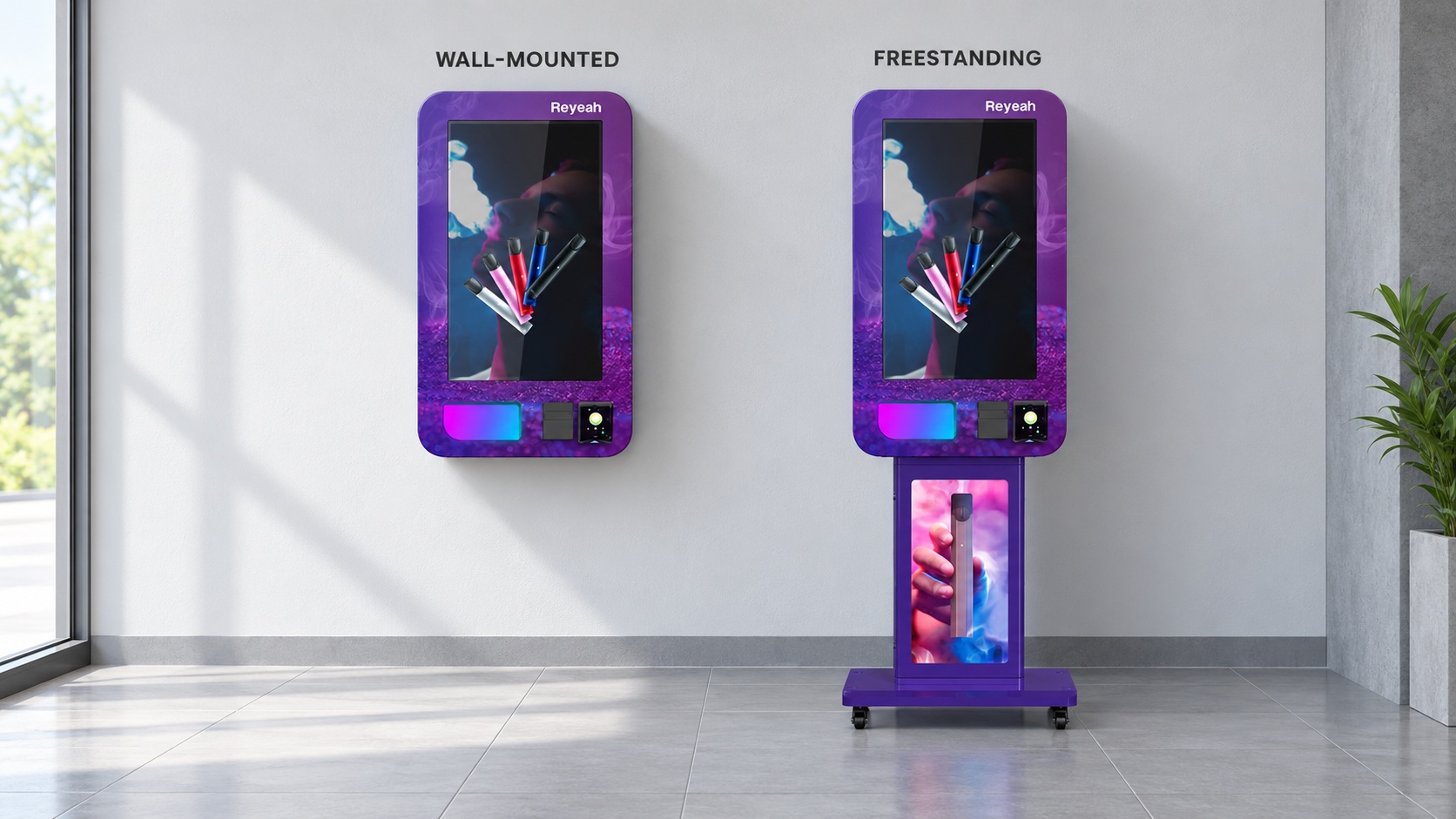
The difference between a wall-mounted and a freestanding vape vending machine becomes clearer during installation than it does in a product photo. A compact cabinet may fit neatly into an interior, but the wall behind it needs to carry the load. A larger floor-standing machine may offer more storage, yet leave too little room to open its door for maintenance.
Both designs have practical advantages. Understanding them means looking beyond the outside dimensions and considering how the equipment will be installed, accessed, and serviced.
A wall-mounted machine keeps its cabinet off the floor. This can make the surrounding area easier to clean and leave more of the floor visible. However, the machine still projects into the room. Its depth, open door, and the space needed to stand in front of it all count toward the installation footprint.
The wall itself deserves careful attention. The mounting arrangement must support the cabinet and its contents, using fixings appropriate for the structure. A finished wall surface alone does not tell you what is behind it. Manufacturer installation instructions should determine the mounting method; a wall-mounted vending manual from Saris, for example, specifically calls for a sturdy supporting wall.
A freestanding machine transfers its weight to the floor through its base or feet. That removes the need for a wall to carry the cabinet, although floor condition, stability, and any required anchoring still need checking. Delivery access matters too. The machine must pass through doorways, lifts, and corners before it reaches its final position.
Neither format should be judged by its closed dimensions alone. A cabinet that fits into a recess may become difficult to service once the door is open. Power connections, ventilation openings, and access panels can also require space beyond the cabinet itself.
| Practical consideration | Wall-mounted | Freestanding |
|---|---|---|
| Structural support | Requires a suitable wall and mounting system | Requires a suitable floor and stable installation |
| Space occupied | Projects from the wall; needs operating and service clearance | Occupies floor space; also needs operating and service clearance |
| Storage capacity | Often limited by a compact cabinet | A larger cabinet may provide more storage |
| Relocation | Requires removal from its mounting and preparation at the new position | Requires handling equipment appropriate to its size and weight |
| Maintenance access | Depends on mounting height and internal layout | Depends on door clearance and internal layout |
Capacity is another area where the details matter more than the format. Freestanding models often have larger cabinets, but cabinet size does not tell you exactly how many items a machine can hold. Internal layout, dispensing mechanisms, and packaging dimensions all affect usable storage.
There is also a difference between the number of selections and total capacity. A machine with more selections may hold fewer units behind each one. Another may offer fewer selections with deeper storage. Meaningful comparisons require the same package dimensions and a clear explanation of how the quoted capacity was calculated.
Packaging compatibility deserves its own check. A carton that fits inside a channel may still catch during dispensing. Its weight, stiffness, and orientation can affect the result. Testing with the actual packaging provides better evidence than comparing cabinet photographs or relying on a general capacity figure.
The daily maintenance differences are less obvious. On a wall-mounted machine, installation height affects access to the screen, collection compartment, locks, and internal components. Mounting it higher may change its appearance, but it can also make routine work awkward. A technician should be able to reach serviceable parts without struggling around the cabinet.
A freestanding machine may provide more internal working room, although that depends on its construction. A large enclosure can still have crowded wiring or components hidden behind assemblies that are difficult to remove. Useful maintenance details include access to the controller, replaceable dispensing units, labelled connections, and available service documentation.
Payment and software features should be compared separately from cabinet style. A wall-mounted enclosure does not inherently mean basic electronics, and a freestanding cabinet does not guarantee more capable software. Cashless payment, transaction reporting, and remote monitoring depend on the installed hardware, controller compatibility, and service configuration. Nayax’s vending documentation, for example, describes MDB communication between the machine controller and payment system, alongside remote management functions. These capabilities come from the integrated system.
The same distinction applies to age verification. An ID reader visible on the front of a machine tells only part of the story. The verification process, supported documents, failure handling, and treatment of personal data require separate examination. Cabinet format alone establishes neither the quality of that process nor whether automated sales are permitted in a particular jurisdiction.
For an existing installation, a useful assessment starts with measurements of the whole working area: the supporting wall or floor, delivery route, door clearance, electrical connection, and service access. From there, the equipment can be evaluated against documented capacity and maintenance requirements.
A wall-mounted cabinet makes sense where its mounting and access requirements can be properly met. A freestanding cabinet needs sufficient floor space and a workable delivery route. In either case, a dimensioned installation drawing and a clear view of the internal layout reveal far more than the front-facing product image.