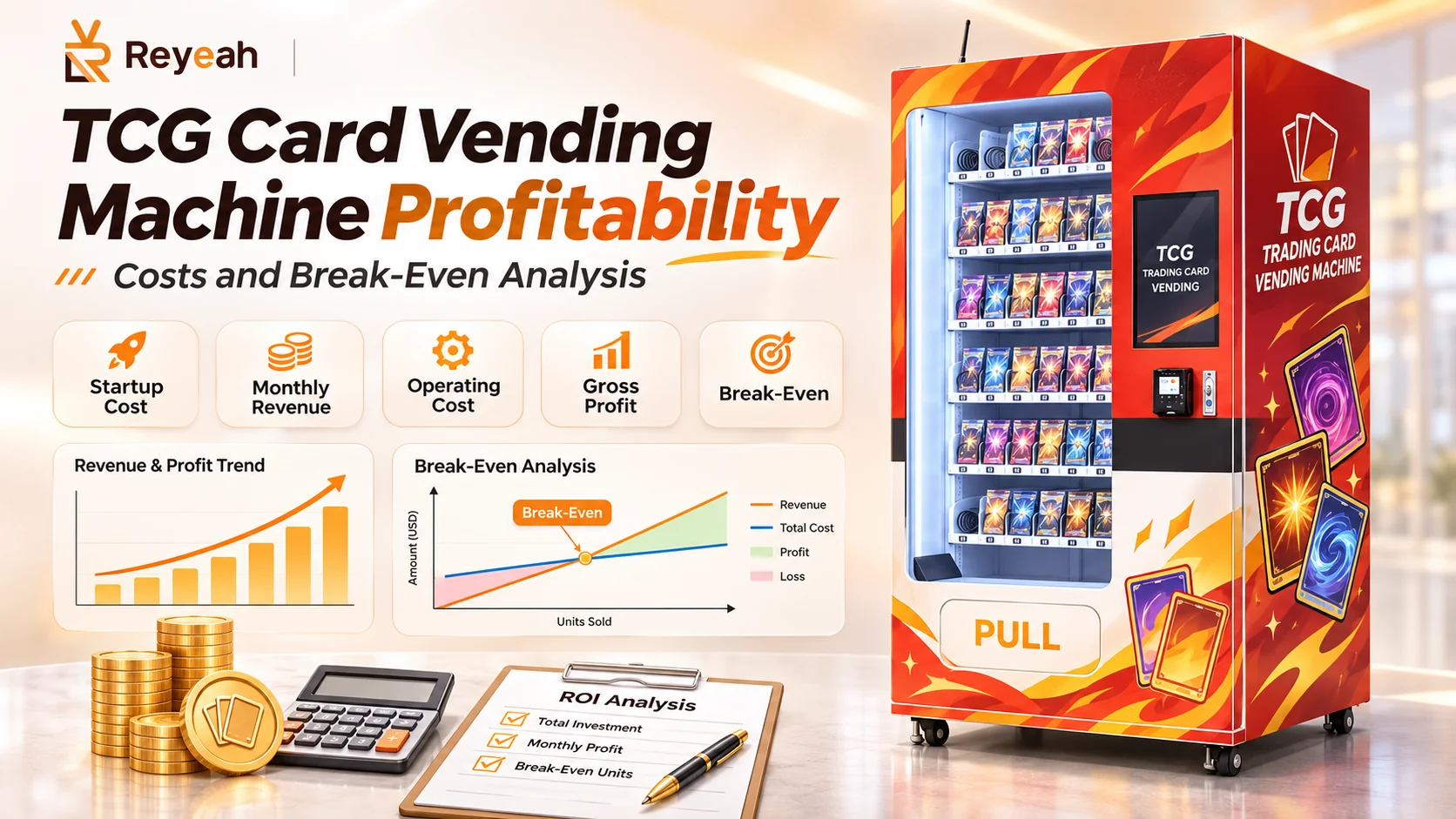
Pokémon card vending machine profitability depends on what remains after stock, payment fees, venue charges and servicing. A busy machine can still earn little if the cards cost too much to source. Use a contribution calculation and a realistic sales forecast before committing to a location.
This guide explains the costs of running an independent trading card vending machine, the difference between operating break-even and investment payback, and how to test the numbers before expanding. All dollar amounts below are hypothetical USD planning assumptions, not Reyeah quotations, market averages or earnings forecasts.
First, distinguish independent machines from official Pokémon machines
Pokémon Center’s official vending machine FAQ states that its machines are owned and operated by The Pokémon Company International and are not offered for sale. Buying a third-party trading card machine is a separate business arrangement.
The analysis here concerns an independent operator purchasing equipment and sourcing authentic sealed products. Equipment ownership does not establish official Pokémon affiliation, a wholesale supply account or permission to use branded artwork. Establish the supply arrangement and intended presentation separately before ordering.
Pokémon card vending machine startup costs
The cabinet price is only one part of the initial cash requirement. Ask for an itemized equipment quotation and separate it from freight, installation, payment activation, stock and a reserve for early operating costs.
| Startup item | Example budget | What to confirm |
|---|---|---|
| Machine and dispensing configuration | $4,000 | Compatibility with the exact packs and boxes |
| Freight and delivery | $800 | Delivery terms, insurance and unloading |
| Installation and commissioning | $300 | Site work and acceptance testing |
| Payment equipment and activation | $200 | What is included in the machine price |
| Opening stock | $1,500 | Available quantities and landed product cost |
| Working cash reserve | $700 | Refill timing, settlement delays and early shortfalls |
| Total initial cash committed | $7,500 | Illustration only; replace every line with actual figures |
Add any applicable import duties, nonrecoverable taxes, branding, site deposits, permits and professional costs. This example assumes none of those additional costs. Recoverable tax and refundable deposits still affect the timing of cash needs, even when they are not operating expenses.
Do not assume a payment terminal or cloud subscription is included because it appears in a product photograph. Confirm the delivered configuration and recurring charges in writing. Our customized vending machine buying guide explains how to specify the equipment before comparing quotations.
Calculate the contribution from each sale
Gross margin on the cards does not equal machine profit. For each product, subtract the landed stock cost and variable selling costs from the selling price. The remainder is the contribution available to cover recurring expenses and recover the initial investment.
Consider an illustrative machine selling one sealed pack per transaction at $6.00. Assume a $4.00 landed stock cost, processing at 3% plus $0.10 per transaction, a venue commission of 10% of sales, and a 2% revenue allowance for unrecovered losses.
| Item | Per pack |
|---|---|
| Selling price | $6.00 |
| Landed product cost | −$4.00 |
| Payment fee: $6 × 3% + $0.10 | −$0.28 |
| Venue commission: $6 × 10% | −$0.60 |
| Loss allowance: $6 × 2% | −$0.12 |
| Contribution per pack | $1.00 |
The product margin before selling costs is $2.00, but only $1.00 remains to pay recurring expenses. If customers buy several packs per transaction, allocate the fixed transaction fee across that basket. If products have different prices or margins, calculate a sales-weighted average contribution instead of applying this pack example to every item.
Define the loss allowance consistently. It should cover net costs you expect to bear from damage, shrinkage, failed transactions and related adjustments. Avoid recording the same refund or damaged stock twice. Replace the allowance with actual operating data once available.
Pokémon card vending machine break-even and payback
Assume monthly recurring costs of $30 for software, $15 for connectivity, $10 for electricity, $90 for refill labor and travel, and $35 for maintenance: $180 in total. These are illustrative costs held constant over the modeled sales range. The venue is paid through the commission already deducted above; there is no additional fixed rent in this example.
Monthly operating cash surplus = monthly units sold × contribution per unit − monthly recurring costs.
At a $1.00 contribution, operating break-even is $180 ÷ $1.00 = 180 packs per month, or six packs per day over 30 days. This covers the modeled running costs. It does not recover the $7,500 initial cash commitment.
| Packs per month | Sales revenue | Monthly operating cash surplus | Simple payback on $7,500 |
|---|---|---|---|
| 120 | $720 | −$60 | No payback while losses continue |
| 300 | $1,800 | $120 | 62.5 months |
| 600 | $3,600 | $420 | 17.9 months |
| 900 | $5,400 | $720 | 10.4 months |
Simple payback divides initial cash committed by a positive, steady monthly cash surplus. The table assumes immediate stable sales, constant stock levels, routine stock replacement included in product cost, and no financing, income tax, depreciation, major repairs or additional capital purchases. It is not an accounting net-profit calculation or a return guarantee.
The reserve and opening inventory remain part of the cash tied up in this illustration. Do not subtract opening stock again as a monthly expense: product cost already accounts for the units sold. If inventory, reserves or stock prepayments increase, reflect that additional cash outflow in a month-by-month cash-flow forecast.
Work backward from your target payback period
A target recovery period gives you a useful sales test. Using the same assumptions, recovering $7,500 over 24 months requires $312.50 per month after running costs. Add $180 of recurring costs and divide by the $1.00 contribution:
That is a required sales level, not evidence that the location can achieve it. Compare it with actual pilot sales and replenishment capacity. If the contribution is zero or negative, additional volume cannot cover fixed costs under the same pricing assumptions.
What changes Pokémon card vending machine profitability?
Stock cost and supply continuity
If the landed pack cost rises from $4.00 to $4.50 while other assumptions stay unchanged, contribution falls to $0.50. At 600 packs per month, operating cash surplus drops from $420 to $120 and simple payback stretches to 62.5 months. Confirm repeatable supply rather than building a forecast around a one-off discounted purchase.
Venue terms and customer demand
Read whether commission applies before or after tax and refunds, whether minimum rent also applies, and who pays for power. Model release-week demand separately from ordinary trading. Foot traffic alone does not show how many visitors will purchase cards at the displayed price.
Packaging damage, downtime and refill capacity
Test sealed packs, sleeved packs and boxes in the proposed dispensing mechanism. Check full channels and the last item, and inspect the packaging after collection. A correctly delivered but creased collectible package can still create a customer complaint.
High demand only produces sales while the machine is stocked and working. Allow for travel, loading time, support and settlement delays. A remote dashboard helps only when the stock count is maintained and someone can respond to alerts.
Run a pilot before buying a fleet
Track units sold by SKU, actual selling prices, product costs, payment fees, commissions, refunds, failed vends, stockout hours and time spent servicing. Include ordinary weeks as well as launches. Reconcile payment settlements with machine records and physical stock.
Use those records to replace the assumptions in your model. A second site may have different demand and servicing costs, so evaluate each location separately. Explore our vending payment options guide when checking transaction costs and local payment support.
Frequently asked questions
How much profit does a Pokémon card vending machine make?
There is no reliable universal figure. In this hypothetical model, 600 packs per month generate a $420 monthly operating cash surplus before financing and income tax. Different stock costs, venue terms or service requirements can change that substantially.
Is break-even the same as getting the machine investment back?
No. Operating break-even covers recurring costs. Payback requires enough additional cash surplus to recover the initial cash committed over time.
Can I use these example figures as a supplier quotation?
No. They demonstrate the calculation. Request a configuration-specific equipment quote, obtain actual supply and payment terms, and rebuild the forecast for your country and location.
Compare trading card vending machines before ordering
Use your product list and cost model to evaluate a real configuration. Review the TCG-12 trading card vending machine and G02 Pokémon card vending machine as potential starting points. Request current specifications and dispensing tests for your packaging before choosing a model.
Send Reyeah your trading card vending project brief with the destination country, product samples or packaging dimensions, planned location, expected sales range and preferred payment methods. Ask for usable capacity, dispensing tests, included equipment and recurring charges so you can assess the investment with your own numbers.