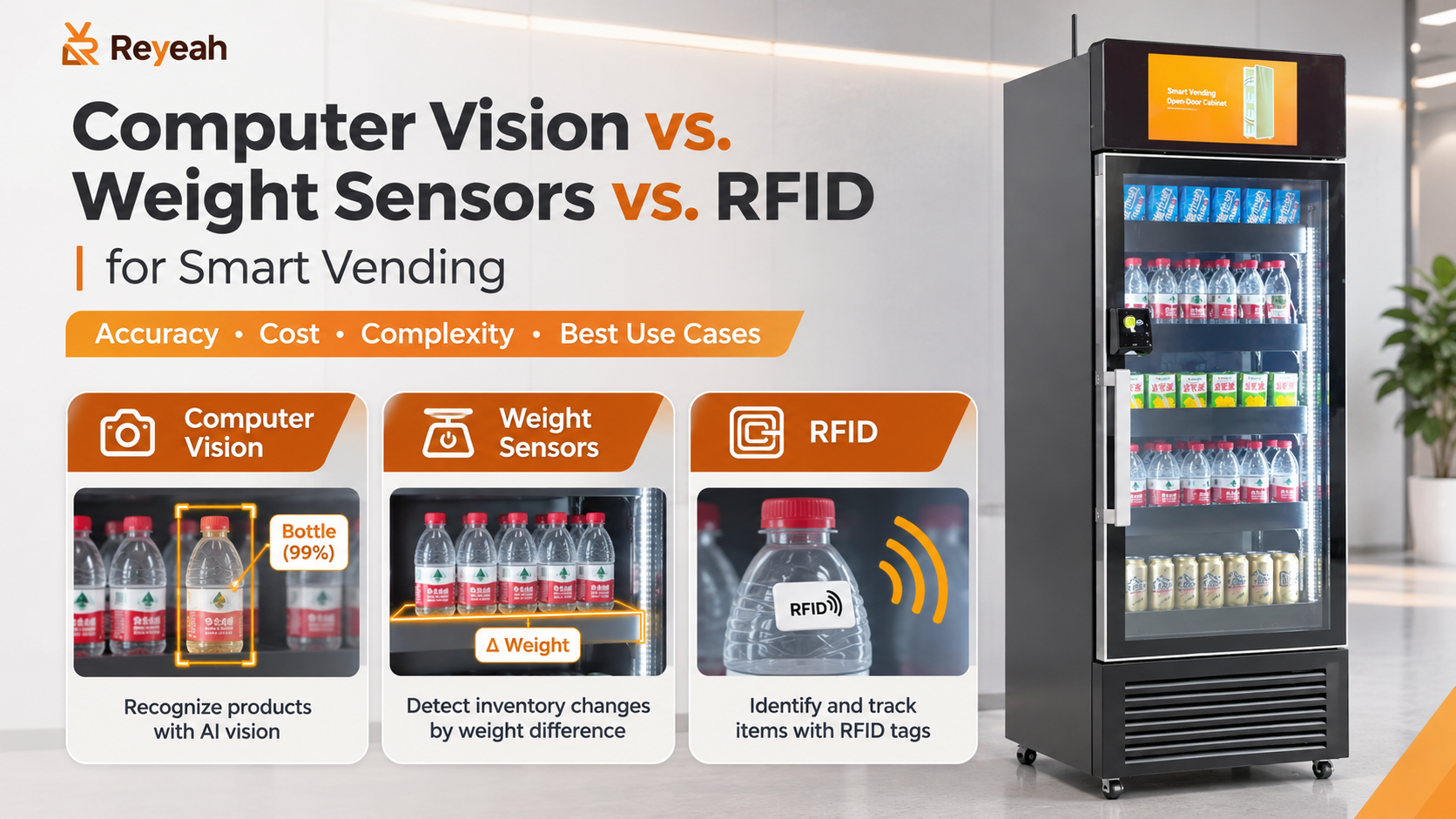
Computer vision vs. weight sensors vs. RFID for smart vending comes down to product fit, refill work and the cost of errors. Cameras identify appearance and movement, scales detect load changes, and RFID readers identify tagged sale units. Compare each approach using the same products and complete shopping sessions.
This comparison focuses on cabinets that customers unlock, open and take products from directly. Conventional machines that release a selected item from a known channel have a different identification workflow. Start by defining the shopping format before comparing recognition technologies.
For an introduction to camera-based checkout, read our guide to AI product recognition in vending machines. Here, the focus is choosing and testing a detection system for a real product assortment.
Computer vision vs. weight sensors vs. RFID at a glance
The table describes common implementations, not guaranteed specifications for every machine. Software, cabinet design and operating procedures can change what each configuration supports.
| Decision factor | Computer vision | Weight sensors | RFID |
|---|---|---|---|
| Primary evidence | Images or video of products and interactions | Load changes on monitored shelves or sections | Identifiers transmitted by product tags |
| Typical product setup | Images or video, SKU enrollment and recognition validation | Measured unit weight, tolerances and section-to-SKU mapping | Item tags encoded and mapped to product records |
| Item-level consumable | Usually no extra recognition label | Usually no extra recognition label | A suitable tag on each tracked sale unit |
| Similar-looking products | Require careful distinction and testing | Can be separated by mapped sections; similar weights can be ambiguous if mixed | Can be distinguished through correctly mapped tags |
| Layout flexibility | Depends on camera coverage and model rules | Often constrained by independently weighed zones | Depends on the validated RF read zone |
| Recurring work | Validate packaging changes; clean cameras; review exceptions | Maintain mapping, calibration and shelf isolation | Apply or verify tags; manage encoding and missed reads |
| Critical pilot test | Occlusion, look-alike packaging and returns | Mixed placement, multiple removals and unstable loads | Tag orientation, packaging effects and read boundaries |
How computer vision identifies products
In camera-based vending, software uses visual evidence to identify goods and determine which items leave the cabinet. Some designs compare shelf contents; others track interactions or combine both approaches. Processing may happen locally, remotely or through a combination of the two. Ask which architecture is actually included.
A camera system needs more than photographs of a full shelf. It must connect a customer’s actions to a final basket: taking two items, inspecting one, returning it and closing the door should result in the correct remaining purchase.
When camera recognition is worth evaluating
Computer vision is a candidate when avoiding item tagging matters and the assortment has visually distinguishable packaging. It can support flexible browsing, but unrestricted product placement should never be assumed. Ask for the approved loading rules and usable capacity with your actual assortment.
What to test before ordering
- Look-alike variants: similar drink flavors, package sizes or promotional designs.
- Occlusion: a hand, another product or the cabinet structure hiding the identifying features.
- Changes in presentation: rotated packs, reflective surfaces, loose pouches and crowded shelves.
- Product returns: putting an item back in its original position and in another position.
Agree on how new SKUs and redesigned packaging are enrolled, who performs the work and when the model becomes available on every machine. Confirm whether charges apply per device, transaction, product update or reviewed exception.
How weight sensors identify removals
Load cells measure changes in force on a shelf, tray or individual section. Software combines those changes with the expected product weight and loading map to infer what was removed or returned. A simple arrangement dedicates each independently weighed section to one SKU.
Weight alone does not uniquely identify a product. If two variants weigh the same and share one sensing zone, a simple before-and-after measurement cannot establish which variant was taken. A known layout, event tracking or another sensor must resolve that ambiguity.
When weighing is worth evaluating
A stable assortment, consistent package weights and disciplined section loading make weighing a useful candidate. Compare the usable number of independently monitored zones with the number of products you need. Extra physical shelf space may not translate into extra supported selections.
What can disturb a measurement?
Check package-weight variation, products leaning on adjacent sections, an item bridging two trays, shelf contact with the cabinet and customer pressure on the shelf. Test a light product on a fully loaded section, as well as several items removed together.
METTLER TOLEDO’s load-cell guidance explains that displayed resolution is not the same as accuracy, and that system performance depends on installation and environmental conditions. For a vending cabinet, request validation at its operating temperature and a clear calibration procedure.
Ask staff to demonstrate replenishment and product reassignment. Putting a different SKU on an accurately weighed tray can still produce an incorrect bill if the software mapping has not changed.
How RFID identifies individual sale units
In an RFID cabinet, readers detect tags attached to products. The system maps those identifiers to product records and uses reads over a shopping session to establish the basket. Individually encoded tags can distinguish two otherwise identical packages without recognizing their printed appearance.
RFID does not require an unobstructed optical view of a label. It does require the tag to be readable in the actual cabinet and correctly associated with the sale unit. Define whether one tag represents a single item, a multipack or a boxed bundle.
When RFID is worth evaluating
RFID is a candidate when item identity matters and a reliable tagging process already exists or can be introduced. It may suit assortments with visually similar goods, provided tag cost, application labor and read performance are acceptable.
Packaging and read zones need testing
Impinj’s packaging guidance notes that liquids, metals and small packages can make RAIN RFID reads more difficult. Tag design and placement therefore need testing on the finished product, including foil packs, cans and bottles where relevant.
Test full and nearly empty cabinets, different tag orientations, overlapping goods and products held near the doorway. Also check that stock outside the cabinet is not incorrectly counted as inside it. A product list that looks right after restocking does not establish that checkout will be correct under all these conditions.
Include tag procurement, encoding, application, verification and exceptions in the operating budget. Existing supplier tags help only if their encoding, data access and read performance fit the proposed system.
Does combining sensors solve the difficult cases?
A hybrid system may use weight changes to support visual recognition, or combine RFID with other event evidence. Independent signals can help resolve ambiguity, but the result depends on how the software reconciles them.
More sensors add components, configuration and maintenance. Compare the measured improvement in correct baskets and reduced review work with those additional costs. The word “hybrid” by itself does not establish better performance.
Compare smart vending technology costs
Request quotations against an identical assortment, usable capacity, destination country and payment specification. A lower-priced cabinet may require more daily labor or extra services to achieve the same result.
| Cost area | Questions to include in the quote |
|---|---|
| Hardware and commissioning | Which cameras, load cells, readers, antennas, computers and calibration work are included? |
| Software and connectivity | Are there device, cloud, transaction, storage or remote-review charges? |
| Product onboarding | Who prepares visual data, measures weights or encodes tags? What does a new SKU cost? |
| Daily operation | How much time is spent refilling, tagging, cleaning, correcting inventory and reviewing exceptions? |
| Failures and support | Who handles incorrect bills, spare parts, refunds and service visits? |
Build a comparison period, such as 36 months, and calculate equipment plus installation plus recurring services, consumables, labor and expected losses. Use the same sales and staffing assumptions for each option. Separate common refrigeration and payment costs from recognition-specific costs to see what is driving the difference.
Test complete baskets, not just product recognition
A frame-level recognition rate does not tell you how often customers receive the correct bill. Define a correct basket as the exact SKUs and quantities taken, with returned items excluded. Report billing performance separately from payment authorization and settlement performance.
- Take one item, several identical items and several different products.
- Pick up an item, inspect it and return it before closing the door.
- Return a product to another permitted position and test any prohibited placement.
- Repeat with a full cabinet, low stock and updated packaging.
- Interrupt the network and power using the supplier’s commissioning procedure.
- Reconcile recorded baskets, final charges, inventory changes and manual interventions.
Agree on the trial size, assortment, operating conditions and acceptance thresholds before testing. Record the proportion of baskets correct without human intervention, the review rate, overcharges, undercharges and time until the final bill. A reviewed transaction may eventually be correct while still carrying an operating cost and a customer delay.
Check data handling and customer support
For camera systems, establish what is captured, where it is processed, retention periods and who can view it. For every technology, check account permissions, transaction records, export options and the process for disputing a charge. Confirm what happens to an open shopping session if connectivity fails.
Frequently asked questions
Which smart vending recognition technology is most accurate?
No single technology wins for every assortment. Compare complete basket results under the same conditions, including exceptions and human review. A claim without its test method is insufficient for choosing a machine.
Can a weight-based machine handle products with identical weights?
It may distinguish them through separate mapped sensing zones or additional signals. Mixed items of the same weight cannot be uniquely identified from a single weight change alone.
Does every RFID vending product need a tag?
Each sale unit tracked by RFID needs a suitable readable identifier. Confirm whether existing tags can be used and how untagged, duplicate or damaged tags are handled.
Can computer vision work without cloud processing?
Some configurations process recognition locally. That does not guarantee offline payment or offline operation of the entire machine. Verify recognition, authorization, storage and synchronization separately.
Choose smart vending technology for your product range
Computer vision deserves testing when visual differences are clear and avoiding tags is valuable. Weight sensing deserves testing when product weights and section loading are controlled. RFID deserves testing when item tagging is practical and individual identity is useful. Use the pilot results to select the final configuration.
To review a camera-based cabinet format, explore the X14 vending machine with AI vision. Use our vending machine specification checklist to prepare a comparable quotation brief. Confirm the supported assortment, software services and test procedure for the configuration offered.
Discuss your smart vending project with Reyeah. Share the destination country, product photographs and samples, package materials, expected SKU changes, target capacity and payment requirements. Ask which recognition configurations are available, how they will be validated and which operating costs are included in the quotation.